
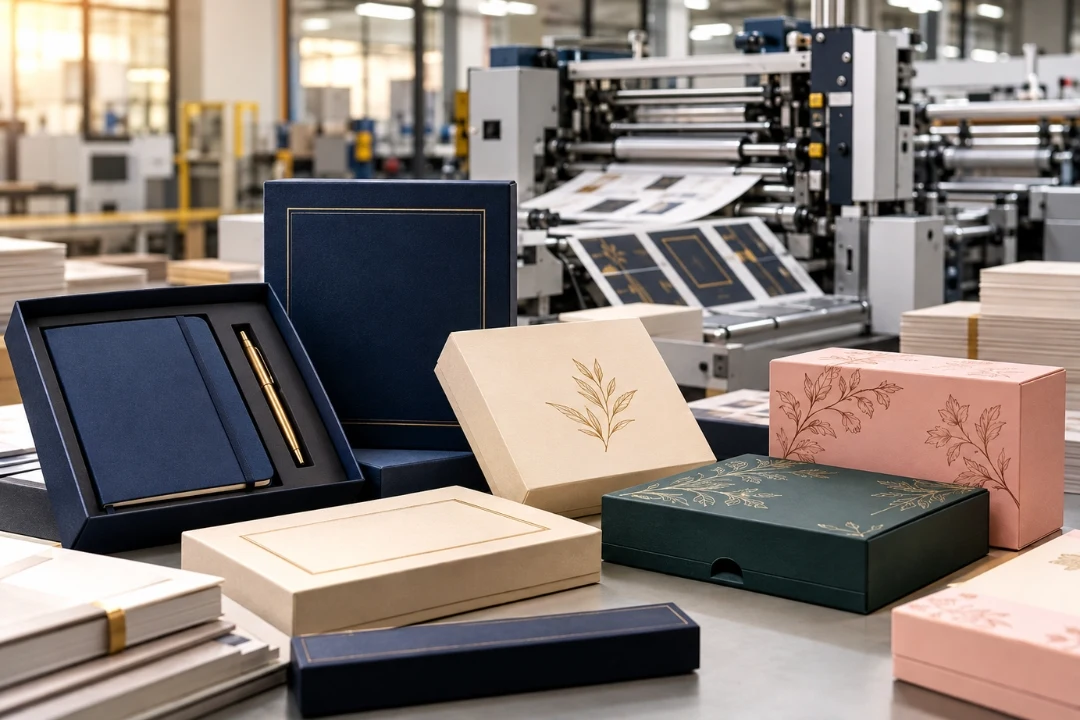
A boxed notebook set looks simple. Gold logo on the lid, a debossed border you can feel with your thumb, a matte surface that’s almost like suede. The customer sees a gift. The converter sees five machines that all had to agree with each other.
That agreement is what this post is about. If you plan to run premium stationery or gift cartons, the gift box packaging machines you pick decide whether a finish looks expensive or just looks off. Here’s what each stage needs, where jobs go wrong, and what to ask before you buy.
Which Gift Box Packaging Machines Do Premium Finishes Need?
The gift box packaging machines that premium finishes need are a film laminator, a hot foil stamper that can also emboss, a die cutter with stripping, and a folder gluer that handles laminated board. Rigid boxes need a separate forming line. Registration between these steps matters more than any one machine’s top speed.
Most stationery boxes (diary sleeves, pen sets, planner boxes, desk gift sets) are folding cartons on duplex or SBS board. They follow one chain: lamination, foil and embossing, die cutting and stripping, then folding and gluing.
| Finish | Machine | What to check |
| Soft-touch or matte lamination | Film laminator | Even tension, no wrinkles or bubbles |
| Foil logos and patterns | Hot foil stamper | Foil feed control, heat, registration |
| Embossing and debossing | Foil stamper or die cutter with heated chase | Tonnage, die quality |
| Cut shapes, windows, flaps | Die cutter with stripping | Accuracy, clean waste removal |
| Final box shape | Folder gluer | Glue placement on finished board |
Hot Foil Stamping and Embossing: Where Premium Is Won or Lost
Foil is a three-variable job. A heated die presses foil against the board for a set moment, and the foil transfers only where the die touches, so heat, pressure and dwell time all have to be right together. Too little of any one gives patchy transfer. Too much blurs the edges. From the machine you want stable temperature across the whole chase, even pressure over the full platen, and a foil feed that doesn’t waste foil.
That last point gets underrated. Stationery logos are small and scattered across a sheet, so foil that advances in fixed long steps burns money. Robus India’s Duo Press die-cutting machine drives its foil shafts with servo motors, three longitudinal and two lateral, each programmable for short or long steps. That cuts foil use and shortens foil changes.
Embossing is a pressure question. A deep emboss on a notebook cover needs tonnage and a heated chase, and an underpowered press gives you a shallow, rounded impression. The Confidence Series 1060AT, part of Robus India’s range of automatic hot foil stampers, is rated at 600 tons of cutting pressure and handles micro, deep and 3D embossing. A practical rule: if you foil and emboss the same job often, buy pressure first and speed second.
One Pass or Three Machines?
Every time a sheet moves between machines, it can shift a little. Foil on one machine, die cutting on another, and the drift shows up exactly where foil meets a cut edge.
Combined machines remove that handoff. York Print in Assam bought a Robus double-platen machine with 600 tonnes per platen and hot foil capability, so it can foil and die cut with stripping in one pass. Robus’s managing director said York’s main concern was avoiding registration problems between foiling and die cutting.
The Duo Press does hot foil, die cutting and four-side stripping in one pass. The Trio Press adds a deep-embossing station, and a patented feature lets you run a single station when the job doesn’t need all three.
The catch: a multi-station machine is bigger and costs more. If most of your work is plain die cuts, it’s overkill.
Soft-Touch Lamination: The Quiet Step
Soft-touch film is thin and unforgiving. Uneven tension shows as wrinkles, trapped air shows as bubbles, and both are obvious on a dark matte lid. A laminator for this work needs steady web tension and clean film cutting between sheets. Robus India’s range includes reel-to-sheet and sheet-to-sheet automatic film lamination, with hot-knife and flying-knife options.
Then there’s the foil question. Foil sticks differently on film than on bare board, so test your foil grade on your actual laminate before you quote a job. Foil over soft-touch is one of the most common premium combinations, which is exactly why it’s worth testing.
Folder Gluers and Laminated Board
Glue doesn’t bond well to film, foil or heavy varnish. The glue flap is usually kept clear of finishes, or the gluer is set up for the surface. Stationery boxes are also small, so format matters. Robus India’s automatic folder gluers start at the 580 and 650 mm Confidence Series models and go up through the 850 and 1100 mm Excellence Series.
Rigid Gift Boxes Need a Different Line
A rigid box is a greyboard shell wrapped in printed paper, so it’s built on a forming-and-wrapping line, not a folder gluer. Finishing still starts earlier: foil and embossing go on the wrapping paper before it’s wrapped, so foil and die-cutting quality still count. Robus India also lists rigid box machinery among its products.
Four Questions to Ask Before You Buy
- What’s the smallest foil element you’ll run? Fine lines and small type need tighter registration and heat control than a big logo.
- Do you foil and emboss the same job often? If yes, look at multi-station machines. If no, a single-purpose stamper is cheaper to run.
- Will the supplier test your own board and film? Ask for a trial on your material, not demo stock.
- Who fixes the machine, and how fast? Robus India has service centres in Pune, Vapi, Bengaluru and Indore.
Frequently Asked Questions
Which machine adds foil to a gift box?
A hot foil stamper. It uses a heated die to transfer metallic or pigmented foil onto the board. Machines with a heated chase and high tonnage can emboss in the same run.
Can foil stamping and die cutting happen in one pass?
Yes, on combined machines such as double-platen or multi-station die cutters. Combining them removes the sheet handoff that causes registration drift.
Do rigid and folding gift boxes use the same machines?
Only partly. Both need good foil and die-cutting equipment for the sheets. Folding cartons then go to a folder gluer, while rigid boxes go to a forming and wrapping line.
Choosing Gift Box Packaging Machines
Robus India has built post-press machinery in Greater Noida since 2016 and has installed over 410 machines. Send the team your board, finish list and monthly volume, and they’ll tell you which combination fits. Start with the finish your customers care about most, then work backwards to the machine.