

A carton plant in Faridabad ran a mechanical folder gluer for eleven years before switching to servo. The owner told his ops manager the upgrade would “pay for itself or it won’t.” Fourteen months later, changeover time on that line had dropped from 45 minutes to under 10. That’s the real question behind this comparison – not which machine has better specs on paper, but whether the switch actually moves your numbers.
If you’re running a folding carton or corrugated packaging line and evaluating your next machine purchase, here’s what actually separates servo-driven and mechanical folder gluers, and where each one still makes sense.
What a Mechanical Folder Gluer Actually Does
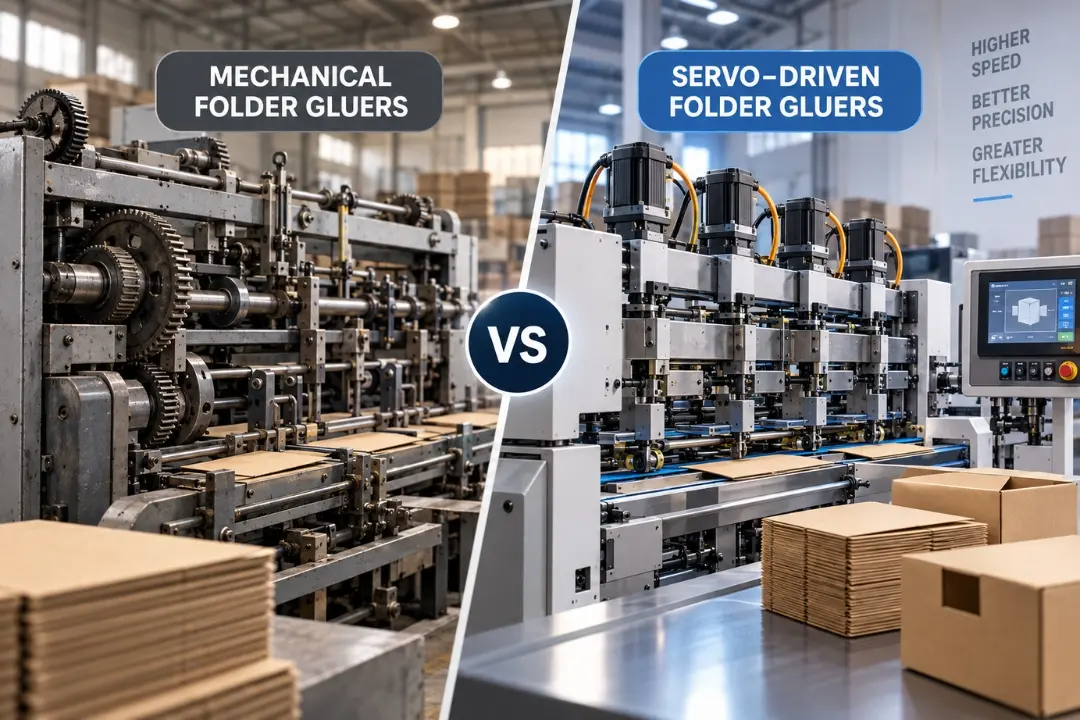
A mechanical folder gluer runs its folding, feeding, and compression sections off one central shaft, using gears, cams, and belts to time everything. It’s a proven design – thousands of these machines are still running profitably across Indian carton plants today. Setup is manual: an operator adjusts guides, rails, and folding plates by hand for each new box style, checking alignment by eye and running test sheets until the fold sits right.
The upside is straightforward. Mechanical machines cost less upfront, have fewer electronic components to troubleshoot, and don’t need a servo technician on call. For a plant running two or three box styles on repeat, with runs long enough to absorb a 30-45 minute changeover, mechanical still gets the job done.
What Changes With Servo Drive
A servo-driven folder gluer replaces the single mechanical shaft with independently controlled motors on each section – feeder, pre-fold, lock-bottom, final fold, compression. Each section can be programmed, memorized, and recalled. Change from a straight-line carton to a 6-corner box, and instead of manually resetting guides, an operator pulls up a saved job profile and the machine repositions itself.
That’s not a small convenience. It’s the difference between changeover measured in minutes versus changeover measured in dozens of sheets of wasted board while an operator fine-tunes alignment by hand.
Independently driven sections also mean tighter registration at higher speeds. Where a mechanical machine has to slow down to hold tolerance on thin or lightweight board, servo sections adjust folding force and timing in real time, which is why servo lines tend to hold quality even as run speed climbs.
Speed and Precision: The Numbers That Matter
Speed comparisons get thrown around loosely in sales conversations, so it’s worth being specific. A well-maintained mechanical gluer typically tops out in the 150-200 meters/minute range on standard carton stock before fold accuracy starts to suffer. Servo-driven machines commonly push past that, and – this is the part that matters more than top speed – they hold fold accuracy consistently at those speeds, rather than accuracy degrading as RPM climbs.
Precision compounds over a shift. A mechanical machine that’s off by half a millimeter on fold registration might not show up on the first hundred cartons. By hour six, on a 10,000-carton run, that drift adds up to a rejection pile your quality team has to explain to the client.
Changeover Time and Waste: Where Servo Pays for Itself
This is the section most vendors gloss over, and it’s the one that decides your ROI.
Every changeover on a mechanical machine burns board. An operator runs test sheets, checks the fold, adjusts a guide, runs more test sheets. On a job requiring six or seven changeovers a week, that waste stacks up in raw material cost and in machine downtime that isn’t producing sellable cartons.
Servo systems with job memory cut that waste dramatically because the machine recalls exact settings instead of an operator rebuilding them by feel. Plants that switch report changeover times dropping from 30-45 minutes to 5-10 minutes – and because the recalled settings are exact, the first sheets off the line are usually good sheets, not scrap.
If your order book has grown more fragmented – shorter runs, more SKUs, faster turnaround demands from FMCG and e-commerce clients – this is usually where the upgrade math tips in favor of servo.
Cost: What You’re Actually Paying For
Servo-driven automatic folder gluer machines cost more upfront than mechanical equivalents – often 25-40% more depending on configuration and section count. That’s the number that stalls a lot of purchase decisions at the approval stage.
But the comparison shouldn’t stop at machine price. Run the math on:
- Board wasted per changeover, multiplied by changeovers per week
- Labor hours spent on manual setup versus automated recall
- Rejected cartons from fold drift at higher speeds
- Downtime cost when the line isn’t running because it’s being reset
For a plant doing high-mix, short-run work, servo’s upfront premium is usually recovered within 12-18 months through waste and labor savings alone. For a plant running long, unchanging orders on the same two box styles, that payback period stretches out, and mechanical can remain the more sensible call.
When Mechanical Still Wins
Not every plant needs servo, and it’s worth saying that plainly. If your production is dominated by long runs of a handful of SKUs, changeover frequency is low enough that the waste and labor differential barely registers. Capital is tighter for a smaller operation, and a well-built mechanical machine – properly maintained – can run reliably for over a decade. There’s also less to go wrong electronically, which matters if you don’t have in-house technicians comfortable with servo drives and PLCs.
The Verdict
Choose servo if changeovers happen several times a week, if your board is getting thinner or your speed targets are climbing, or if fold consistency at scale is costing you rejections. Choose mechanical if you’re running long, stable jobs on a tight budget and don’t need the flexibility.
Industry data backs this pattern – reporting on newer corrugated folder gluer launches has repeatedly pointed to independently driven, servo-controlled sections as the feature manufacturers lean on for folding precision at speed, not raw mechanical horsepower. And buying guides for the category consistently flag servo drive technology, paired with job memory recall, as the combination that cuts changeover time and operator error, which lines up with what plants report after switching over.
If you’re weighing this decision for your own line, it helps to walk through your actual order mix, run lengths, and changeover frequency with someone who’s set up both machine types across Indian carton plants – Robus India’s team offers consultation and installation support to help you work out the real payback period before you commit.
Bottom Line
The upgrade isn’t about chasing the newer technology – it’s about whether your changeover frequency, run lengths, and board costs make the servo premium pay for itself. Run your own numbers before deciding either way.