
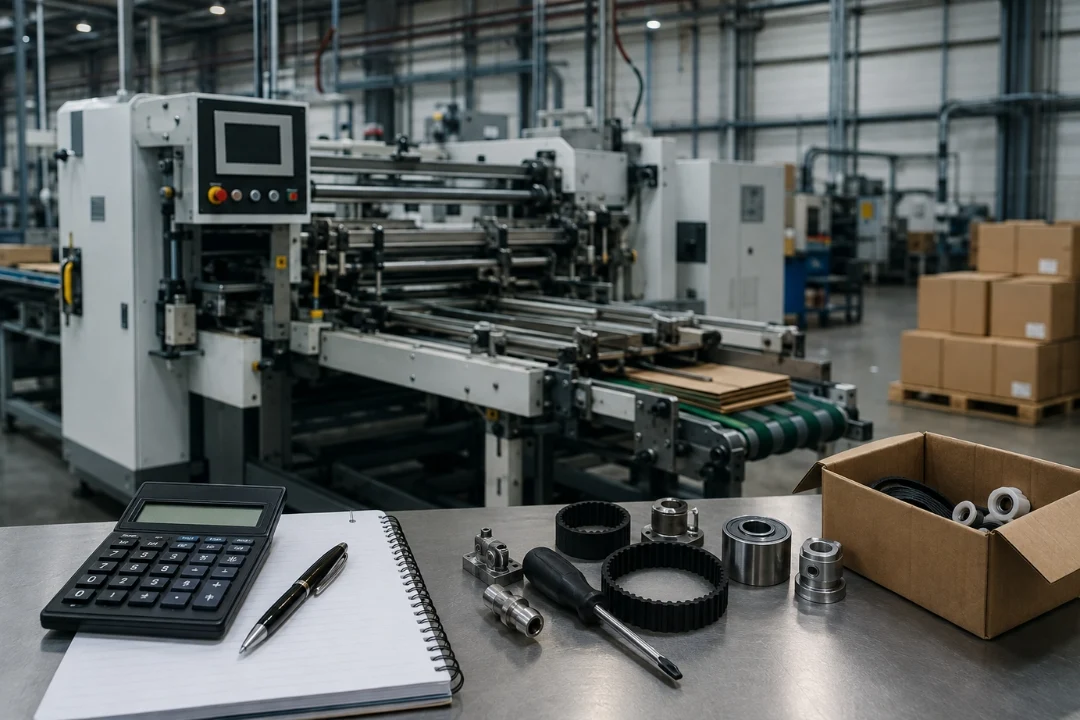
A packaging machine quote never tells the whole story. The number on that proforma invoice is just the entry ticket – what you pay after installation is where most buyers get surprised.
Ask any plant manager who’s run a folder gluer or die cutter for five years, and they’ll tell you the price barely scratches the surface. Industry analysts who study equipment lifecycle costs have found that purchase price often makes up only 20-30% of a machine’s total cost over a decade – the rest goes into running it, fixing it and replacing it.
If you’re evaluating a carton packaging machine right now, here’s where the real money goes after the invoice is paid.
Installation and Site Preparation
Most quotes cover the machine. Few cover what it takes to get that machine running on your factory floor.
Foundation work, electrical panel upgrades, compressed air lines, and structural changes to fit the machine’s footprint can add 5-10% on top of the machine cost. Older factory buildings need more of this – a panel wired for 15 kW machines doesn’t automatically handle a servo-driven folder gluer pulling three times that load.
Then there’s commissioning: the days, sometimes weeks, your engineer and the supplier’s technician spend fine-tuning the machine before it hits rated speed. That’s paid time with no output to show for it.
Spare Parts and Consumables
This is where buyers get blindsided most often, especially with imported machines.
Rubber rollers, glue nozzles, cutting dies, timing belts, and sensors wear out on a schedule the sales brochure never mentions. On machines built with proprietary components, a single replacement part can take four to six weeks to arrive from overseas – and cost triple what a locally sourced equivalent would.
Before you sign anything, ask two questions: what wears out fastest on this specific model, and how far away is the nearest stock of those parts? A machine that’s ₹5 lakh cheaper upfront isn’t cheaper if you’re paying air-freight premiums for a die every quarter.
Maintenance Isn’t Optional – It’s a Line Item
Every packaging machine needs a maintenance budget, and it’s rarely the number the sales team quotes you.
Preventive maintenance – lubrication schedules, belt tension checks, glue system cleaning, alignment calibration – keeps small issues from becoming five-figure repairs. Skip it, and you’re not saving money, you’re deferring a bigger bill. We’ve put together a preventive maintenance schedule for die-cutting machines that breaks this down by daily, weekly, monthly, and annual tasks, and it applies to most carton machinery with small adjustments.
Reactive maintenance – the kind you do after something breaks – costs more in every direction: emergency technician visits, expedited parts shipping, and the production you lose while the line sits idle.
Downtime Is the Cost Nobody Puts on a Quote
Here’s the math most buyers skip: what does an hour of stopped production actually cost your plant?
Multiply your hourly output value by the hours a machine sits idle for repairs, part replacement, or operator troubleshooting, and downtime often becomes the single largest hidden cost over a machine’s life. It’s also the hardest to budget for because it depends on things you can’t fully predict – how reliable the build quality is, how fast your supplier responds, and how far the nearest service engineer is from your plant.
This is exactly why after-sales response time deserves as much weight in your buying decision as the machine’s rated speed.
Operator Training and Manpower
A machine is only as productive as the person running it. Training costs – both the direct fee if the supplier charges for it, and the indirect cost of lost output while operators climb the learning curve – add up fast, particularly on machines with digital HMIs and servo controls that differ from what your team is used to.
High operator turnover compounds this. Every time a trained operator leaves, you’re back to square one on productivity until the replacement is up to speed. Factor in retraining cycles when you’re calculating what a machine will really cost you to run.
Energy Consumption Adds Up Quietly
Two machines with identical output speeds can have very different power bills. Servo-driven systems typically draw less power than older hydraulic or pneumatic designs doing the same job, but the difference only shows up on your electricity meter over months, not on a spec sheet at the time of purchase.
If you’re running multiple shifts, this gap between an efficient and an inefficient machine can run into lakhs annually – money that never appears anywhere in the original purchase decision.
Depreciation and Resale Value
Not every machine holds its value the same way. Build quality, brand reputation, and the availability of spare parts all influence what you can recover if you sell or trade in the machine later.
This is also where the new-versus-used decision loops back in. If you’re weighing a lower upfront cost against long-term reliability, our breakdown of new vs refurbished carton packaging machines walks through how that trade-off plays out in real maintenance and resale numbers, not just sticker price.
Compliance, Insurance, and Warranty Gaps
Depending on your industry, machines may need periodic safety certification, calibration audits, or compliance checks – costs that rarely show up in a sales conversation. Insurance premiums also shift based on the machine’s safety rating and claims history for that model.
And read the warranty terms closely. A warranty that excludes electronics, or requires you to use only the OEM’s technicians at premium rates, isn’t the safety net it looks like on paper. Some of the most painful “hidden” costs are hidden in the fine print of a document you already signed.
How to Actually Calculate What a Machine Will Cost You
Before you commit, work through this instead of just comparing quotes:
- Add up 5-year maintenance costs, not just the first-year service contract
- Price out the top 5 wear parts and check local availability, not just cost
- Estimate downtime cost per hour based on your own production value
- Compare energy draw at your actual operating hours, not the spec sheet’s ideal conditions
- Ask for reference customers running the machine 3+ years, not just recent buyers
- Check spare parts lead time in writing, not as a verbal assurance
A thorough total cost of ownership breakdown usually reveals that the cheapest machine on paper isn’t the cheapest machine to run – and by the time that becomes obvious, you’re several years into a bad decision.
The Real Question to Ask Before You Buy
The purchase price tells you what a machine costs to acquire. Everything above tells you what it costs to own. Before signing any purchase order, ask your supplier directly: what’s the average annual spend on parts and service for this exact model, from customers who’ve run it for three years or more? A supplier confident in their build quality will have that answer ready. One who dodges the question is telling you something too.
If you’re evaluating carton packaging machinery and want a straight answer on what a machine actually costs to run – not just to buy – talk to our team about your production volumes and we’ll walk you through the real numbers.