

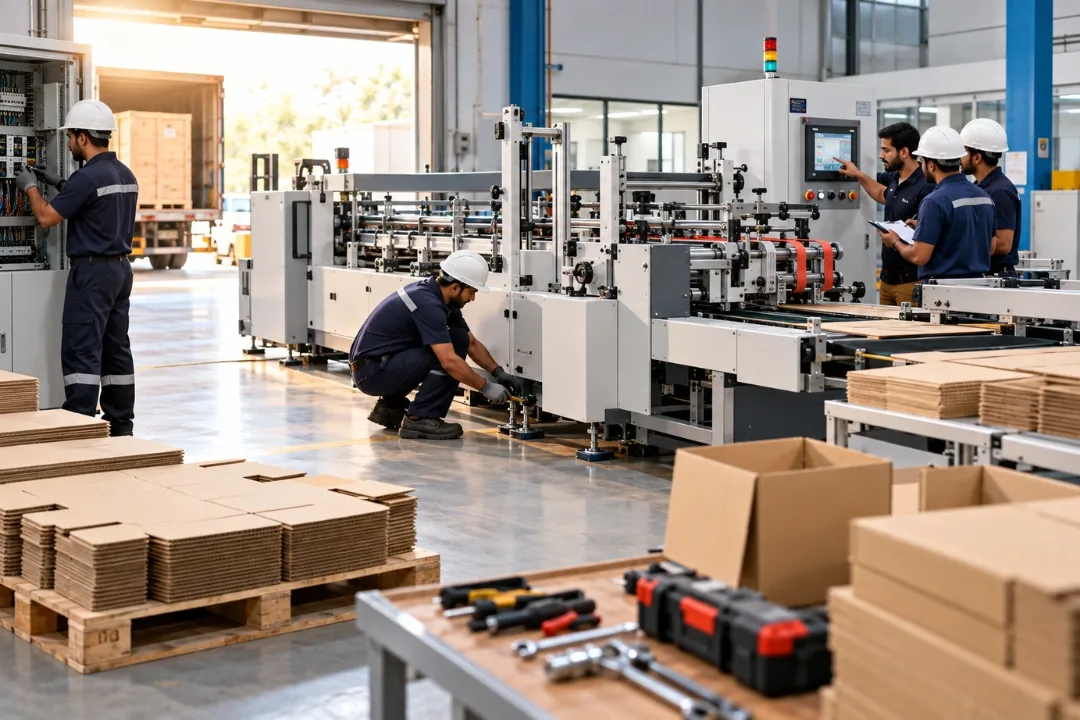
The purchase order is signed, the advance is paid, and a crate the size of a small room is heading to your plant. Now comes the part nobody puts in the brochure.
Machine installation and commissioning is the stretch between delivery and your first sellable carton. Get it right and the machine reaches its rated speed within days. Get it wrong and you spend months chasing skewed folds and glue lines that wander. Here’s what actually happens, step by step, using carton packaging machines like folder gluers and die cutters as the example.
What Is Machine Installation and Commissioning?
Machine installation is the physical work of positioning, levelling and connecting a machine to your power, compressed air and floor. Commissioning is the testing that follows: running the machine, adjusting it and proving it meets the specification you agreed on. Installation puts the machine in place. Commissioning shows it works.
People use the two words as if they mean the same thing. They don’t, and it matters when you read a quote. Some vendors price installation only and leave you with a running machine and no proof of performance. Check which one is in your contract.
Step 1: Get the Site Ready Before the Machine Arrives
Picture the truck pulling in, the crates coming off, and the main crate turning out to be four centimetres too wide for your shop door. It happens. It’s also entirely avoidable.
A pre-installation visit catches this. At Robus India, an engineer visits your location to assess the installation environment before anything ships. The check usually covers:
- A power supply with a proper disconnect, matched to the machine’s voltage and phase
- Clean, dry compressed air at the required pressure
- A flat floor that can carry the machine’s weight
- A clear path from the gate to the final spot, including door heights and turning space
Moisture in the air line deserves extra attention. It’s a common reason pneumatic parts turn sticky and feeders start misfiring.
Step 2: Unpacking, Positioning and Levelling
Check the crates against the packing list first. Photograph any damage while the transporter is still standing there. Parts go missing or get knocked about in transit, which is why a visual inspection is part of any site acceptance test.
Then comes levelling. On a long machine like a folder gluer, a frame that sits slightly twisted shows up later as cartons drifting off line. The engineer sets the base, checks it with a precision level and fixes it in place. It’s slow, dull work, and it can’t be rushed.
Step 3: Connecting Utilities and the First Power-Up
Electrical and air connections go in next. Before any board is loaded, the engineer checks motor rotation, safety guards, interlocks and emergency stops. Then the machine runs empty. A no-load run shows whether the drives, belts and sensors behave when nothing else can be blamed.
Only after that does anyone feed material.
Step 4: Commissioning With Your Own Board
This is where the real work starts. A factory trial uses the vendor’s stock and the vendor’s dies. Your plant has different board, different glue and different humidity. So commissioning means running your own jobs: your carton style, your substrate, your die.
Agree the pass or fail numbers in writing before the test, not after. Typical criteria are running speed, wastage percentage, fold accuracy and glue-line consistency. Without numbers, “it looks fine” becomes the acceptance standard, and that’s a bad thing to discover a month later.
What Is the Difference Between FAT and SAT?
A factory acceptance test (FAT) happens at the manufacturer’s site before shipping. A site acceptance test (SAT) happens at your plant after installation. FAT catches design and build problems. SAT catches transport damage, wiring faults and integration problems that only appear under your real power, air and working conditions.
Neither replaces the other. This FAT and SAT comparison from PQE Group points out that real utilities like compressed air can only be tested at the owner’s site, and that SAT paperwork is usually simpler than FAT paperwork. For a step-by-step view, Control.com explains how to perform a site acceptance test, including why some buyers tie the final payment to a passed SAT.
Step 5: Operator Training Before the Engineer Leaves
Commissioning is the cheapest time to train. The engineer is on site, the machine is set up for your jobs, and nobody’s under delivery pressure yet. Put your actual operators on the machine, not just the owner. They should leave knowing how to change dies, clear a jam, clean the glue system and spot early signs of wear.
If only one person gets trained, you’ve built a single point of failure. People take holidays. People quit.
Step 6: Handover and the Paperwork That Matters
Handover isn’t a handshake. Ask for these:
- A signed acceptance report with the test results
- The operating manual, wiring diagram and air diagram
- A spare parts list with part numbers
- A preventive maintenance schedule
- The warranty start date, in writing
How Robus India Handles Installation and Commissioning
Robus India has built carton packaging machines in Greater Noida since 2016 and has installed over 410 machines for nearly 90 customers. The process starts with a site check, moves to a schedule that disrupts your production as little as possible, and then to the installation itself. After that, the same team covers troubleshooting, scheduled maintenance and replacement parts through its installation and after-sales service.
Anil V Ghuge, MD of Shweta Print O Pack, called the installation of his machine hassle-free and said the Robus team supported them well. If you’re comparing an automatic folder gluer against other options, ask every vendor to put their installation scope in writing. The answers tell you a lot.
Common Questions
How long does machine installation and commissioning take?
It depends on the machine and how ready your site is. A compact die cutter and a large-format folder gluer and stitcher are very different jobs. Ask for a written schedule at quotation stage, and confirm what you need to have ready by which date.
Who is responsible for installation, the buyer or the supplier?
The contract decides. Usually the buyer prepares the foundation, power and air, and the supplier positions, connects and tests the machine. Read the quote for exactly what’s included.
Can you skip commissioning if the machine ran fine in the factory?
No. Transport, power quality, humidity and your own materials all change how a machine behaves. Skipping commissioning saves a few days and risks months of quiet losses.
Before you sign your next purchase order, ask one question: what exactly happens between the truck leaving and the first approved carton? If the answer is vague, push for detail.