
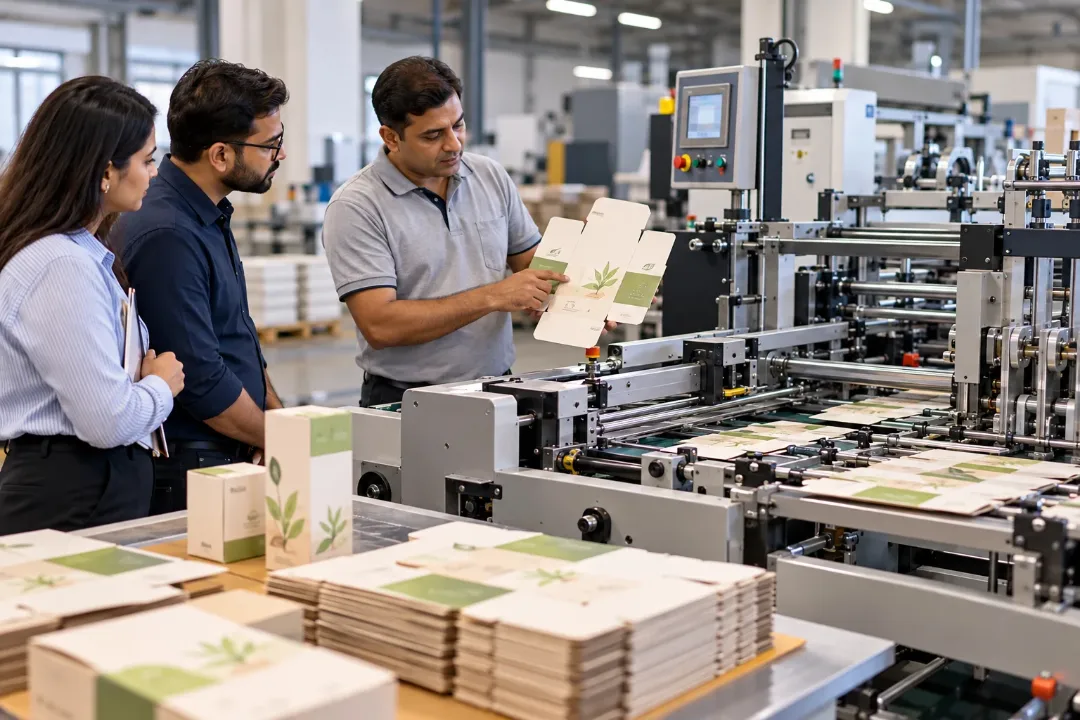
A packaging machine demo is a live test run where the manufacturer operates the machine on your own material while you watch the speed, the setup and the finished output. Most demos take half a day to a full day. By the end, you should know whether the machine can make your product at the quality and pace you need.
Most buyers treat it as a presentation. That’s the mistake. Any machine runs well on the supplier’s favourite sample, so a demo only tells you something when it runs your job.
Before the Packaging Machine Demo: What to Send and What to Decide
The demo starts before anyone switches the machine on. Ask the supplier what they need from you, then send real production material. For carton work, that means your printed sheets or blanks, the actual board grade and GSM, and the coating or lamination you use. Plain test paper proves very little.
Formal acceptance tests work the same way. The buyer’s own sample material goes to the manufacturer ahead of time, as this breakdown of how a factory acceptance test is structured explains.
Then write down your pass marks before you arrive: target output per hour, the wastage you can live with, your smallest and largest carton, and how many changeovers you run per shift. Skip this and you’ll end up judging the machine on a feeling. At 4 pm, with a friendly engineer pouring you tea, the feeling is usually positive.
What Happens During a Packaging Machine Demo, Step by Step
Most demos follow the same sequence.
- Walkthrough and safety briefing: The engineer shows you the guards, emergency stops and control panel before any power goes on.
- Setup on your material: The operator loads your stock, adjusts the guides and sets the machine for your job.
- Slow trial run: The first sheets or cartons run at low speed to check feeding, registration, and fold lines.
- Ramp to production speed: Speed goes up in stages toward the rated figure while you watch for drift.
- Output inspection: You pull samples yourself instead of only taking what the operator hands you.
- Fault tests: Starve the feeder, cause a jam, and see how the machine reacts.
- Changeover: The team switches to a second job so you can time it.
Steps 2 and 7 deserve the most attention. Setup and changeover time decide how much a machine earns you across a month, and a sales deck never shows them. Time both with a stopwatch. If the engineer needs forty minutes to set up a machine he runs daily, your operator won’t do it in ten.
Step 5 is where people get shy. Don’t be. Take cartons from the middle of the run, not the start, and erect a few of them. Folds that look fine flat can fall apart once the box is opened.
What to Check on Carton Post-Press Machines
- Folder gluer: Check glue line position and strength, and see what an automatic folder gluer does with your smallest carton. Crash-lock bottoms should open cleanly when erected.
- Die cutter: Look at how the cut registers against the print, how cleanly the waste strips, and whether sheets stack square at delivery.
- Flute laminator: Test bond strength across the full sheet, then check that laminated sheets stay flat after they cool.
Packaging Machine Demo vs Factory Acceptance Test vs Site Acceptance Test
These get mixed up constantly, and the mix-up costs buyers money.
| Stage | When | Where | Purpose |
| Demo | Before you order | Manufacturer’s plant or online | Show the machine can handle your job |
| Factory acceptance test (FAT) | After the order, before shipping | Manufacturer’s plant | Verify the machine meets the agreed specification |
| Site acceptance test (SAT) | After installation | Your factory | Confirm performance in real working conditions |
Packaging World’s factory acceptance test roadmap draws the same line. The factory test checks that the machine works as specified, while the site test deals with your actual plant conditions. It adds that most suppliers will agree to a free retest if the machine fails, and suggests timing how long common wear parts take to replace.
Put the FAT pass criteria into the purchase agreement before you pay the advance. A demo result that lives only in your memory can’t be enforced.
What Should You Ask During a Packaging Machine Demo?
- What is the real speed on my material, not the rated speed?
- How long does a changeover take, and who performs it?
- Which components are branded, and are spares stocked locally?
- What do training and the first year of service look like?
Ask for the answers in writing and have them added to the quotation.
Red Flags at a Packaging Machine Demo
Be wary if the supplier insists on running only their own samples, or if the operator never lets you near the controls. The same goes for a machine that runs well below its rated speed with no explanation, and for a demo that “can’t be arranged” until you’ve paid a deposit.
Packaging Machine Demo FAQs
How long does a packaging machine demo take?
Typically half a day for one machine. Allow a full day if you want to run two jobs and time a changeover.
Can I bring my own material to a demo?
Yes, and you should. Send it ahead so the supplier can prepare the setup.
Should I attend in person or online?
For a first purchase, go in person. A video call works for a second look, but you can’t feel a vibrating frame or run your thumb along a glue line through a screen.
Robus India has built carton packaging machines in Greater Noida since 2016 and has installed over 410 machines for nearly 90 customers. If you want to see a machine run your own board, request a live demo with our team.