
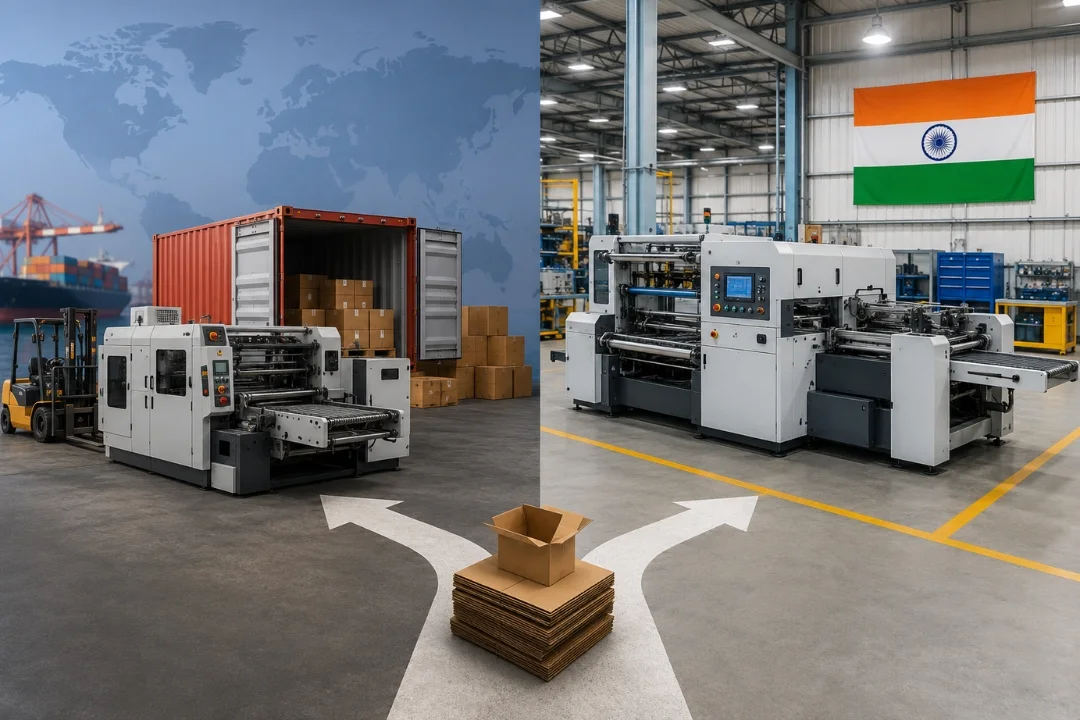
Every carton or corrugated box plant reaches this fork in the road eventually. You’ve outgrown your current setup, you have a budget approved, and now someone in the room says “let’s just import a German or Chinese line, it’ll be worth it.” Someone else pushes back. Both of them are partly right, and partly guessing.
I’ve sat through enough of these conversations to know the decision usually gets made on gut feeling, not numbers. So here’s the actual math, the actual support reality, and what tends to bite people six months after the machine is running.
What “Import” Really Costs, Beyond the Invoice
The quoted price on an imported die cutter or folder gluer is never the price you pay. By the time the machine lands at your factory gate, you’ve added:
- Basic customs duty – typically around 7.5% on capital machinery, depending on classification
- IGST at 18%
- Social welfare surcharge of roughly 10% on the duty amount
- Ocean freight, marine insurance, and port handling
- CHA (customs house agent) fees and inland transport from the port to your plant
- Currency risk between quotation and payment, which on a six-month lead time can move 3-5% either way
Stack those together and a machine quoted at, say, ₹1.2 crore FOB can land closer to ₹1.55-1.65 crore once it’s actually on your factory floor and running. None of this shows up in the glossy brochure or the first email from the overseas sales agent.
Then there’s time. Ocean freight from Europe or China runs 4-6 weeks by itself, and that’s before you count manufacturing lead time (often 4-6 months for a built-to-order line), customs clearance, and the wait for the OEM’s engineer to get a visa and fly in for commissioning. A full cycle from PO to production can stretch past 8-9 months.
Where Indian-Made Machinery Actually Wins
Domestic manufacturers don’t carry any of the import overhead above, and that shows up directly in the quote. Machines built in India by an established manufacturer typically run 25-40% cheaper than a comparable imported model, purely from skipping duty, freight, and currency exposure. That gap alone can fund a second machine, an extra shift’s worth of working capital, or a proper AMC for the next three years.
Lead times are shorter too, since there’s no ocean crossing and no waiting on a foreign engineer’s travel schedule. Most Indian manufacturers can turn a standard configuration around in 8-12 weeks, and the commissioning engineer is a same-day drive away, not a six-week visa process away.
The quality gap that used to justify importing has also narrowed a lot in the last decade. Servo-driven feeders, touchscreen HMI panels, vision-based glue inspection, CE-rated electricals – these aren’t exclusive to European or Japanese lines anymore. Many Indian manufacturers now build to the same component standards (SEW, Siemens, Schneider drives are common across both) while assembling and calibrating the machine at home, where they can walk the shop floor daily instead of managing it over email.
The Part Nobody Mentions Until It’s Too Late: Support
This is where the real cost of importing shows up, usually a year in, not on day one.
When an imported machine throws a fault at 11 PM on a production night, you’re not calling a local number. You’re emailing a support desk in a different time zone, waiting for a response, and then waiting again for a spare part to clear customs – which, for anything urgent, can mean days of downtime on a line that was supposed to be running double shifts. Spare parts for imported machines often have to be re-imported themselves, with the same duty and freight math applied all over again, except now you’re paying rush shipping on top.
Domestic manufacturers solve this by being, quite literally, closer. An engineer can be on-site within a day for anything serious, spares sit in a local warehouse instead of a container ship, and there’s no language or time-zone gap when you’re trying to describe a fault at 2 AM. Robus India’s after-sales service, for instance, is structured around exactly this – pre-installation site checks, scheduled maintenance visits, and component replacement handled by engineers who are a phone call and a few hours away, not a support ticket in a different country.
A Straight Cost Comparison
| Imported Machine | Indian-Made Machine | |
| Landed cost vs quote | +25-35% (duty, IGST, freight, SWS) | Minimal addition, mostly local transport |
| Typical delivery | 6-9 months | 8-12 weeks |
| Spare parts lead time | Weeks (re-import + customs) | Days (local stock) |
| Service response | Email/ticket, cross-timezone | Same-week site visit |
| Upfront price | Higher | 25-40% lower on average |
So, Which One Actually Makes Sense?
If you’re running an ultra-high-volume operation where a specific European brand’s throughput numbers are the difference between winning and losing a contract, importing can still make sense – some jobs genuinely need that ceiling.
But for the vast majority of folding carton and corrugated converters in India, the case for importing has gotten thinner every year. India’s packaging sector is one of the fastest-growing in the world, and a large share of that growth is mid-sized converters upgrading their post-press lines, not the handful of plants running at the absolute top end of speed. According to IBEF’s industry data, the sector is expanding at 22-25% annually, and most of that expansion is happening in exactly this segment.
For that segment, a well-built Indian folder gluer or die cutter gets you to the same production floor, at a lower landed cost, with a service engineer who actually answers the phone in your time zone. The premium you’d pay for an import badge increasingly buys you paperwork and shipping delays, not extra performance.
Before you sign anything, do three things: get the full landed cost in writing (not just FOB), ask for a reference customer you can actually call or visit, and check what the service response time looks like on paper versus what previous buyers say it looks like in practice. That last one tells you more than any brochure will.