

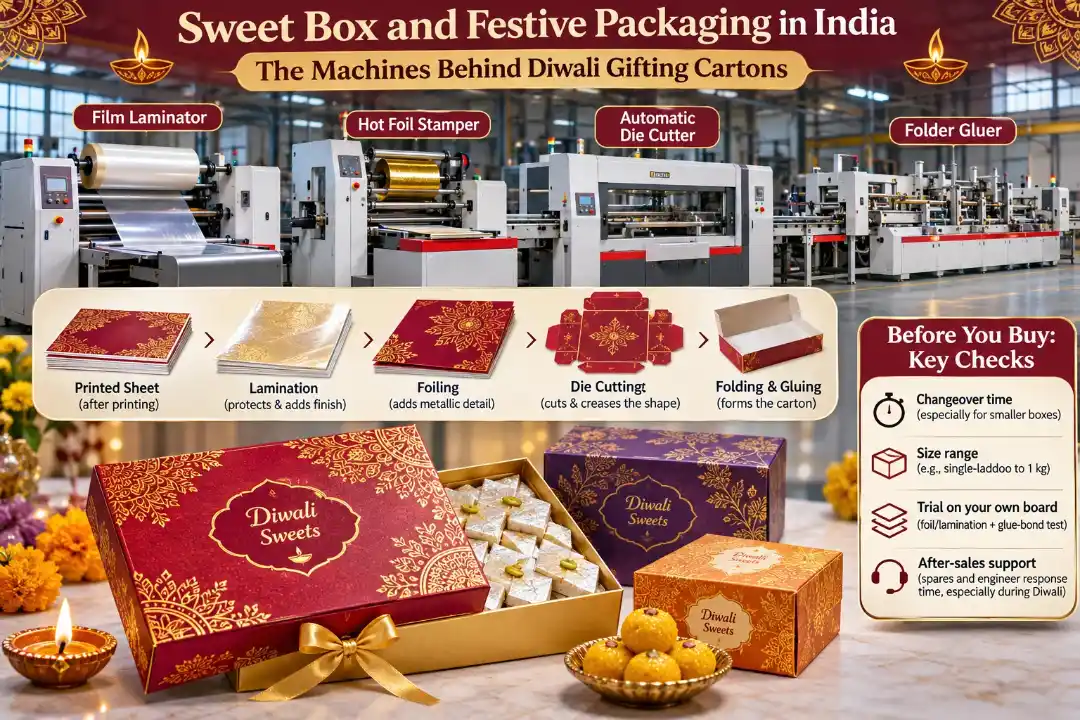
A Diwali sweet box looks simple. Fold, fill, tie a ribbon. But the carton in your hands has been through four or five machines before a halwai puts a single piece of kaju katli inside, and a slip at any of them shows up later as a lid that won’t sit flat or a flap that pops open in a hot car. This post walks through the sweet box packaging machines behind India’s festive cartons, what each one does, and what to check before the next Diwali order book fills up.
Which sweet box packaging machines make a Diwali carton?
A sweet box passes through a post-press line after printing: a film laminator protects the surface, a hot foil stamper adds metallic detail, an automatic die cutter cuts and creases the shape, and a folder gluer folds and glues the blank into a carton. Rigid gift boxes need separate box-making equipment.
The order matters. Foil and lamination go on the flat printed sheet, so they come before the cut.
One clarification, because search results blur it. Many listings for a “sweet box packaging machine” are actually cartoners, which load sweet trays into a finished carton. This post covers the other kind: the machines that make the carton in the first place.
Die cutting is where festive jobs get won or lost
Walk through any mithai market in October and count the sizes: 250 g boxes, 500 g, one kilo, four-piece boxes, single-laddoo boxes. Each one needs its own die and its own make-ready, and most run in short batches. That’s the real pressure on a converter. Not top speed. Changeover time.
A good automatic die cutter holds register through cutting and creasing, so the blank reaches the folder gluer with clean fold lines. If a crease is even slightly off, the gluer can’t rescue it, and you find out when a whole pallet of boxes won’t close.
Stripping is the quiet bottleneck. Windows, locking tabs and insert slots leave waste that has to separate cleanly from the blank. If it clings, someone ends up pulling it free by hand, and your automatic line slows to the speed of one person.
Foil and lamination make a box look like a gift
Plain board says sweet shop. Gold foil on deep red, with a film finish over the rest, says gift. A hot foil stamper presses metallic leaf onto the board with heat and pressure, and it needs the same registration discipline as the die cutter. Film lamination happens earlier in the line. It guards against scuffs in transit and wipes clean when ghee touches the surface, which on a mithai box it eventually will.
Both finishes also cause the most common gluing headache, which is the next stop.
The folder gluer is the machine nobody photographs
The folder gluer takes the die-cut blank, folds it along the creases, applies glue to the seam and presses it until the bond sets. Robus India’s automatic folder gluer handles straight-line, crash-lock bottom, four-corner and six-corner boxes, which includes styles common on a mithai counter.
Here’s the catch. Glue doesn’t grip a fully varnished or laminated flap well, so printers either block out the glue area or match the adhesive to the coating. Test that on your actual foiled, laminated board before Diwali volume arrives, not during it.
How one Noida converter built a business on sweet boxes
A Noida converter shows how this works in practice. According to The Packman’s report on Print O Pack Global Offset, the company started in Delhi in 1985 as Chawla & Sons and made sweet boxes as job work. Today it produces sweet boxes for Haldiram and Bikanervala, plus toy, TV and green cracker boxes. A Robus folder gluer went into its Noida plant in 2020, followed by a laminator and an order for a die cutter.
Nivesh Chawla, one of the second-generation owners, said they reordered because the machines delivered on quality and speed at a competitive price, and because Robus supported them after the sale. That second part matters more in October than any spec sheet does.
Why the box matters to the mithai inside
Sweets don’t last. FSSAI’s guidance note on traditional milk products puts milk-based sweets at roughly one to four days of shelf life, kaju katli at about seven days and besan laddoo near thirty days. The note also says pre-packaged milk-based sweets should carry the ingredient list, the date of manufacture and a best-before or use-by date.
In an FSSAI festive-season survey around Delhi in late 2019, which tested 1,041 milk product samples, loose products showed more quality and hygiene problems than packed ones. For carton design, the takeaway is plain: leave a clean panel for a label or date code, and put it on the die line from the start instead of fixing it after printing.
What to check before you buy a sweet box packaging machine
Four questions worth asking any supplier, Robus India included:
- How long does a changeover take on your smallest box? Ask for a live demo, not a brochure figure.
- What’s the size range, from a single-laddoo box to a one-kilo tray?
- Can you run a trial on your own foiled, laminated board, with a glue-bond test?
- Who answers the phone in the second week of October? Get spares and engineer response times in writing.
FAQ
Can the same machines make rigid sweet boxes?
Not entirely. Folding cartons come from die cutters and folder gluers, while rigid boxes need separate box-making equipment. Robus India lists rigid box machinery as its own category.
What is the difference between a folder gluer and a cartoner?
A folder gluer forms the empty carton from a die-cut blank. A cartoner packs product, such as a tray of sweets, into a carton that already exists.
Who is Robus India?
Robus India is a Greater Noida manufacturer of carton packaging machines, including folder gluers, die cutters, laminators and hot foil stampers for folding carton and corrugated converters. Its website says it has installed over 410 machines for nearly 90 customers since 2016.
Planning capacity for next Diwali? Send Robus India your box sizes and board spec, and ask for a trial run before you commit. A few hours at the machine will tell you more than a catalogue.