

Hot melt vs cold glue in folder gluers: which should you use?
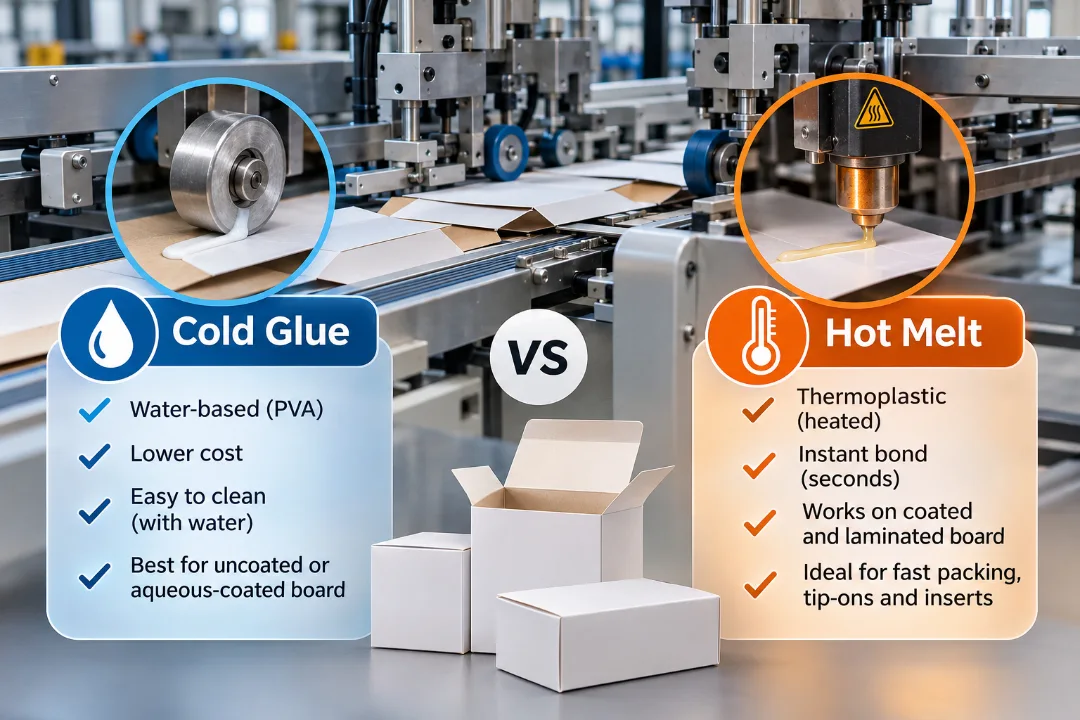
Pick the wrong adhesive and you’ll find out at the customer’s warehouse, when cartons pop open at the seam. The hot melt vs cold glue decision looks like a minor line on a folder gluer quote. It isn’t. It sets your running speed, your cleaning routine and the jobs you can say yes to. Hot Melt vs Cold Glue: The Short Answer Use cold glue for most folding cartons and corrugated boxes where the glue flaps are uncoated or only aqueous-coated. It’s cheaper and cleans up with water. Use hot melt when you need an instant bond, or when the glue flaps are coated or laminated and cold glue won’t grip. Most plants land on a split: cold glue as the default, hot melt for the awkward jobs. Some machines carry both. How Each Glue System Works on a Folder Gluer Cold glue is a water-based adhesive, usually a PVA-type emulsion, applied at room temperature through a glue wheel or nozzles. It sets as the board absorbs the water. That’s the catch: it needs porous stock and some time under pressure in the delivery section. Hot melt is a thermoplastic. It’s heated in a tank, pushed through heated hoses to the nozzles and laid down as beads or dots. Once it touches cooler board it grips within seconds. It doesn’t rely on absorption, so it holds on surfaces where cold glue just slides. You pay for that in hardware. The tank, hoses and nozzles all need heat, and somebody has to keep them clean. Either system can lay lines, dots or a mix, and the pattern is usually preset at the controller. Inspection can run on top of that. KAMA’s FF 52i checks glue quantity and line length, then ejects any carton that misses the mark. Hot Melt vs Cold Glue Folder Gluer: Side by Side Factor Cold glue Hot melt Set time Slower, needs compression Seconds Surface tolerance Porous or aqueous-coated board Handles coated and laminated board better (still test) Adhesive cost Lower Higher, plus heating energy Cleaning Warm water Harder, residue hardens Machine hardware Glue wheel or nozzles Heated tank, hoses, nozzles Recycling Easier Stickies risk unless repulpable Typical jobs Straight-line, crash-lock, corrugated Coated stock, tip-ons, inserts, fast packing When Cold Glue Is the Better Choice For packaging, Baumer hhs’s Chris Raney told DPS Magazine’s folder gluer feature that cold glue is the preferred method. It’s easier to apply and less expensive. His condition: no varnish or print on the glue flaps. That condition matters more than it sounds. Run 100,000 straight-line cartons with clean flaps and the adhesive savings pile up, so cold glue wins. Corrugated shipping boxes, which rarely carry fancy coatings on the flaps, sit in the same camp. The same article notes that KAMA’s basic FF 52i runs straight-line boxes on a simple gluing disc and only adds nozzles for lock-bottom boxes, which shows how little hardware cold glue can need. Cold glue bites back on varnished flaps. Raney said absorption is slow there, so the bond is unlikely to hold well. And if nobody flushes the nozzles at the end of a shift, dried glue will clog them by morning. Small habit, fewer stoppages. When Hot Melt Makes More Sense Hot melt earns its place in a few specific situations. Coated or laminated board is the big one. A fast line is another, since a hot melt bond sets in seconds and the carton leaves the delivery section ready to pack. Cold glue boxes often need to sit under compression a while longer. Tip-ons and inserts lean on hot melt too, and Raney said cold glue is unlikely to be used for direct mail work at all. Hot melt isn’t a magic fix for coatings, though. His point about clean glue flaps applies to it as well. The better fix is at the source: keep flaps free of varnish, or treat them. KAMA’s Marcus Tralau said in the same article that inline plasma treatment on the FF 52i lets printers flood-coat sheets instead of masking the flaps, which saves flexo plates and setup time. Heat has a limit too. For direct mail, Raney puts the ceiling at about 300°F. Which Glue Is Better for UV-Coated Cartons? Hot melt usually grips UV-coated board more reliably than cold glue, but neither likes a full UV coat on the flap. The safest route is to keep glue flaps clear of coating or treat them with plasma. Test the actual sheet, not a sample from a different job. Does the Glue Choice Affect Recycling? It can. Hot melt fragments that survive repulping turn into stickies, which cling to mill felts and rollers. A PPWR guide on repulpable hot melts and stickies tells converters to prefer repulpable grades, pattern-coat instead of flood-coat, and ask suppliers for an INGEDE Method 12 stickies classification. FEFCO’s corrugated recycling guidance has also leaned toward cold-set adhesives over hot melt. If your cartons ship to Europe, treat adhesive data as a spec-sheet item, not an afterthought. Can One Folder Gluer Run Both? Yes. Some builders sell machines with both systems. Lamina, for example, equips its compact folder gluers with hot melt as standard and fits cold glue on special order. That flexibility costs more up front, but it lets you take a coated cosmetics job on Tuesday and a corrugated order on Wednesday without changing machines. How to Choose for Your Plant Four questions settle most cases. What’s on the glue flap? Bare board or an aqueous coat points to cold glue. UV, lamination or metallised film points to hot melt or plasma. How soon is the carton packed? Straight off the line favors hot melt. How long are your runs? Long runs on plain stock favor cold glue’s lower adhesive cost. Where does the carton end up? Fibre-recycling markets favor cold glue or a repulpable hot melt. If you’re specifying a machine, ask the supplier which glue configuration each model supports and what … Read more