

Live Demo :

ROBUS INDIA at CHINA PRINT 2025 | Discover how we enhance your packaging production with precision and efficiency! | Meet us at Booths: W2-007 (Dayuan), A3-522 (YCIA), E4-001/002 (Xinxing) | 15–19 May 2025 | China International Exhibition Center (Shunyi Hall), Beijing | info@robusindia.com | +91 81783 09461 | www.robusindia.com

Rigid Box vs Folding Carton: Which Suits Your Product Category?

Rigid Box vs Folding Carton packaging comparison for premium and everyday products

A brand manager at a mid-size cosmetics company once asked us a simple question: “Why does my competitor’s lipstick box feel like a jewellery case, while mine feels like a cereal box?” The answer had nothing to do with the printing or the artwork. It came down to one decision made months earlier – rigid box or folding carton. That choice affects unit cost, shipping volume, shelf presentation, and how a customer feels the moment they pick up the pack. Get it wrong and you either overspend on packaging a commodity product doesn’t need, or you undersell a premium product with packaging that feels cheap. This guide breaks down where each format wins, backed by real production numbers, so you can match the packaging to the product category instead of guessing.   The Core Difference: Construction, Not Just Look A folding carton is cut from a single sheet of paperboard, printed, scored, and shipped flat. It’s assembled – by hand or by machine – only at the point of packing. A rigid box (also called a set-up box) is built from thick chipboard, wrapped in a separate decorative sheet, glued at the corners, and delivered to the brand already in its final, permanent shape. It never folds flat again. That one structural difference explains almost everything else: Board thickness: Folding carton stock typically runs in the 250–350 GSM range. Rigid box board is a different animal entirely – usually 1.5mm to 3mm chipboard, sometimes thicker for luxury lines. Assembly: Folding cartons fold and lock on a packing line. Rigid boxes arrive pre-formed; there’s no assembly step for the brand, but there’s a wrapping and corner-pasting process at the converter’s end. Shipping volume: Flat cartons stack efficiently. Rigid boxes occupy their full volume even when empty, so freight and warehousing cost more per unit. Unit cost: Folding cartons run anywhere from a few cents to around a rupee or two per unit at scale. Rigid boxes cost several times more, largely because of the board weight and the extra wrapping step. Neither format is “better.” They’re built for different jobs.   Where Folding Cartons Win Folding cartons dominate categories where volume, cost efficiency, and shelf-ready speed matter more than a luxury unboxing moment: Food and confectionery – cereal boxes, snack cartons, chocolate boxes that need to move through automated packing lines fast Pharmaceuticals – tamper-evident, serialised cartons where regulatory compliance and print accuracy matter more than tactile weight FMCG and personal care basics – soaps, toothpaste, shampoo cartons produced in the hundreds of thousands Consumer electronics accessories – chargers, cables, and mid-tier gadgets where the carton needs to look clean but doesn’t need to carry the brand’s entire premium story India’s own packaging numbers back this up. Market research on India’s paper and paperboard packaging industry shows folding cartons remain one of the largest product categories by volume, with personal care and cosmetics packaging expected to grow faster than most other segments as brands push for shelf differentiation. That growth is coming from folding cartons upgraded with heavier board, soft-touch coatings, and foil work – not necessarily a wholesale shift to rigid boxes.   Where Rigid Boxes Earn Their Cost Rigid boxes justify their higher price when the packaging itself is part of what the customer is paying for: Fragrance and premium cosmetics – where the weight and resistance of the lid signal quality before the customer even opens it Jewellery and watches – protection matters, but so does the theatre of opening the box Premium electronics – phones, headphones, and gadgets positioned at the top of their category Gifting, corporate hampers, and liquor packaging – where the box is often kept and reused Limited editions and festive launches – where the packaging carries as much marketing weight as the product India’s paper and packaging industry associations track this shift closely, and the pattern across premium categories is consistent: when a customer is paying a premium price, the packaging is expected to reflect that, and a rigid box tends to deliver a return the folding carton can’t match in that specific context.   The Machinery Side of the Decision This is the part most packaging guides skip, but it’s the part that actually determines whether you can produce either format profitably. A folding carton line typically needs a printing/die-cutting stage followed by a folding carton production setup – die-cutting, folding, and gluing running as one continuous, high-speed process. Because cartons are lightweight and flat-packed, the equipment is built for volume: think tens of thousands of units per shift, with changeovers measured in minutes. A rigid box line is a different investment altogether. The board has to be die-cut, corners pasted, wrapped, and pressed – a sequence that demands precision at every station because there’s no folding forgiveness once the box is formed. Our own rigid box making machine handles cardboard from 0.8mm to 3mm and wraps boxes up to 350mm wide at speeds up to 35 pieces a minute, with servo-controlled feeding and corner pasting to keep the finish consistent box after box. That’s a slower, more deliberate process by design – rigid box production isn’t meant to compete with folding carton speed, it’s meant to compete on finish quality. If you’re a converter deciding what to add to your production floor, the honest question isn’t “which machine is better.” It’s “which product categories does my client base actually need packaged, and at what volume?” A printer serving FMCG and pharma clients gains more from a folder-gluer and die-cutter upgrade. A converter chasing cosmetics, gifting, or premium electronics accounts will get more return from a rigid box line, even though the per-unit output is lower.   A Quick Decision Checklist Ask these four questions before locking in a format: Does the customer touch the packaging before buying, or does it arrive sealed in secondary packaging? Shelf-facing products lean rigid for impact; sealed or e-commerce-only products often don’t need to pay for it. What’s the retail price point? As a rough … Read more
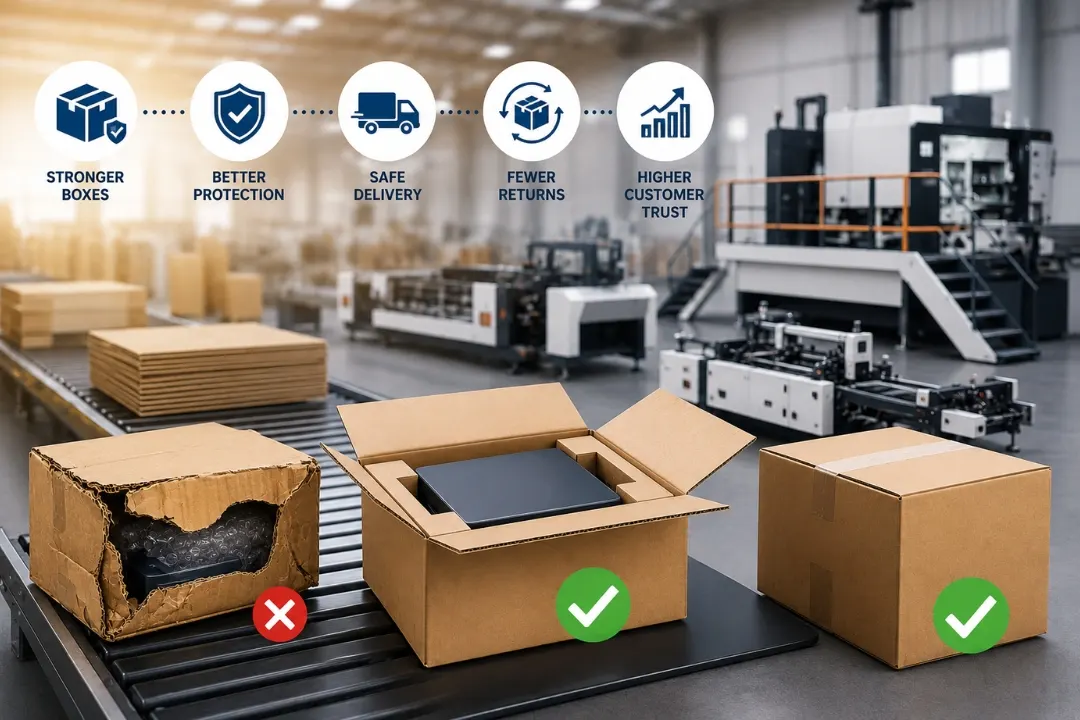

E-Commerce Returns & Damaged Boxes: How Corrugated Box Making Machines Reduce Loss

E-Commerce Returns packaging image showing damaged and secure corrugated boxes in a modern warehouse with box-making machines

Nobody talks about how expensive a return actually is. You sell a product for ₹800. The customer gets it with a dented corner, a cracked lid, or a shattered screen. They raise a return request. You spend another ₹150–₹400 on reverse logistics, restocking, re-inspection, and re-dispatch. In some cases, the product can’t even be resold. That ₹800 sale just turned into a net loss. This is the reality of e-commerce returns in India and globally, and it happens every day – at scale. What’s wild is that most of this is preventable. Not through better policies or faster customer support, but through better boxes.   The Numbers Behind E-Commerce Returns Are Hard to Ignore Global merchandise returns crossed $890 billion in 2024. The e-commerce return rate was 16.9% last year and is expected to hit 19.3% in 2025. In India, return rates on platforms like Meesho and Flipkart routinely run between 20% and 40% depending on the category. The bigger problem inside these numbers: 80.2% of returns happen because the product arrived damaged. Not the wrong size. Not changed mind. Damaged. And here’s the part that should bother anyone running an e-commerce or packaging business – 51% of customers who receive a damaged shipment don’t buy from that brand again. They don’t complain loudly, they just leave. That’s the damage you don’t see on a returns dashboard.   Why Boxes Actually Fail in Transit A corrugated box failure during shipping is rarely random. There are a handful of reasons it keeps happening, and they’re all fixable. The box is the wrong size: When a box is too big for the product inside, the product moves. It shifts, bounces, collides with itself or the sides. That movement causes damage – especially for anything fragile, electronic, or with sharp edges. Undersized boxes have the opposite problem: the flutes get crushed under external pressure, and the structural integrity collapses. The board strength doesn’t match the product weight: A single-wall corrugated board works fine for a 500g item. Use the same board for a 5kg appliance, and it won’t survive three handling points. The edge crush test (ECT) rating needs to match the actual load – and it often doesn’t when brands order generic stock boxes. Glue joints and folds are inconsistent: In high-volume manual or semi-manual operations, box assembly quality varies. A weak glue line or an uneven fold means the box opens at a seam under pressure. It doesn’t take much – one drop, one compression on a conveyor – and the product is exposed. Each of these failure points happens before the courier ever picks up the shipment. They’re baked into the packaging at production time. That’s where the fix needs to happen too.   What Better Machines Actually Change The connection between machine quality and e-commerce return rates is direct, even if it’s not talked about enough. Folder Gluer Machines The folder gluer is what assembles the flat sheet into a finished box. When a folder gluer is running precisely – consistent glue pressure, accurate folding alignment, correct speed calibration – the boxes it produces are structurally sound every single time. The seams hold. The corners are clean. When the machine is old, poorly calibrated, or running too fast for the board type, defects get baked in. Not every box fails, but enough do that the return rate climbs. Robus India’s Automatic Folder Gluer Machines – built in three series: Excellence, Performance, and Confidence – are designed for corrugated carton production with high-precision folding and consistent glue application. For e-commerce brands dealing with high SKU volumes, this kind of consistency matters more than most realise.   Die Cutting Machines Die cutting is what gives each box its exact dimensions. A precise die cut means the box folds cleanly, closes tightly, and fits the product with minimal void space. Void space is underrated as a damage source. Every centimetre of space inside a box is room for the product to move. Custom die-cut boxes – sized specifically for a product’s actual dimensions – remove that space. Products arrive the way they were packed. Robus India’s Automatic and Semi-Automatic Die Cutting Machines handle a range of corrugated sheet sizes, which makes it practical to produce custom box profiles for different SKUs without massive setup overhead.   Flute Laminator Machines For heavier products – electronics, kitchenware, large D2C shipments – single-wall board just isn’t enough. 3-ply and 5-ply corrugated board absorbs significantly more impact and resists compression under warehouse stacking loads. Robus India’s High Speed 3-Ply and 5-Ply Flute Laminator (Model: RI-3LF-1450HS) produces multi-wall corrugated board at production speed. For any brand that’s repeatedly seeing damage on heavier items, switching to a higher-ply board is often the fastest fix.   Right-Sizing Is Where Most of the Gains Come From There’s a concept in packaging called right-sizing – it just means making a box that fits the product. Obvious in theory, rarely done well in practice. Most Indian e-commerce sellers work with 8–12 standard box sizes and try to fit hundreds of SKUs into those. It works well enough until it doesn’t – until a customer posts a photo of their product rattling inside a box three times too large, or arrives with half the corner caved in. Right-sized boxes cut internal product movement to nearly zero. They also reduce DIM weight shipping costs, which for high-volume sellers can be a significant monthly saving. And they use less material per box, so the cost per unit drops. Getting there requires a machine setup that supports custom sizing – automated die cutting and folder gluing that can shift between box dimensions quickly. Robus India’s E-Commerce & Q-Commerce Box Making Machine was built specifically for this: fast format changes, high output, and accurate dimensions across a wide range of box sizes.   Packaging Is Part of the Brand, Whether You Think About It or Not There’s a reason unboxing videos exist. Customers notice packaging. A box that arrives clean, intact, and well-formed tells them something … Read more

Looking for a Braille Machine with Standard Marburg Medium?

Kindly fill out the form below to request more information.