

4-corner and 6-corner box gluing: machine requirements explained
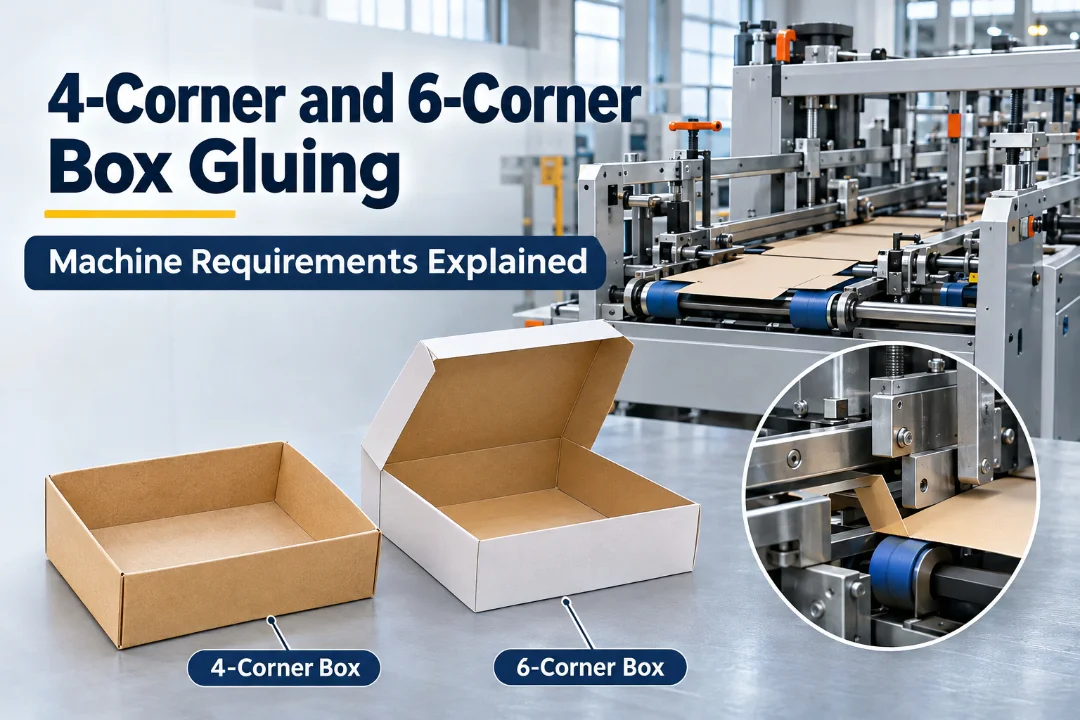
A standard folder gluer can’t make a 4-corner or 6-corner box. It folds along straight lines and glues one seam. Corner boxes ask for more: the machine has to fold back panels, hold them, and glue every corner before the tray takes shape. That’s the job of a 4 and 6 corner box gluing machine, which is a folder gluer fitted with extra folding hardware and tighter control. Below you’ll find what that hardware is, what to check before buying, and where buyers go wrong. What does a 4 and 6 corner box gluing machine need? A 4 and 6 corner box gluing machine needs a dedicated corner module with servo-driven folding hooks, multi-point glue application, an accurate feeder, adjustable conveyor belts and saved job settings for quick changeovers. A straight-line setup alone can’t fold and glue corner flaps accurately at production speed. 4-corner vs 6-corner boxes A 4-corner box is a tray: one base, four walls, and a glued flap at each corner. Most are open-top. Food trays, e-commerce boxes and retail packs are typical uses. A 6-corner box adds two more glued corners, usually because the blank carries an extra panel such as an attached lid or a second wall. More panels mean a longer folding sequence and more room needed in the folding section. 4-corner box 6-corner box Glued corners 4 6 Typical form Open tray Tray with an extra panel, such as an attached lid Folding demand Back-fold of four flaps Longer fold sequence Machine need Corner module Corner module with more folding space The six requirements that matter Corner module with hook folding The hooks do the hard work. They catch the rear flaps and fold them back while the blank keeps moving. Robus India’s 4 & 6 corner attachment uses a servo-driven hook system with photoelectric sensors for the back-folding step. A servo drive makes settings easier to repeat than manual adjustment, so ask any supplier how their hooks are driven. Enough folding length Corner boxes need more fold distance than straight-line cartons, which is why some builders add an extended folding and closing section. Compare that section’s length with your largest blank, not your average one. A glue system built for several points Corner boxes glue in more than one place, so look for multi-nozzle heads and glue-line detection. Cold glue suits most uncoated board. Coated or laminated board often needs hot melt or varnish-free glue strips in the artwork. Settle this with your printer early, because the machine can’t fix a blank that has varnish on the glue flap. Feeder and belts that handle the blank Corner blanks show skew fast. A blank that enters the feeder tilted arrives at the delivery with a crooked corner. Automatic blank alignment shortens feeder setup, and upper carriers that lift for board thickness matter because microflute and 300 gsm carton don’t sit the same way in the same belts. Job memory and quick changeovers Changeover time decides whether corner boxes pay off on short runs. According to Bobst’s EXPERTFOLD 50 | 80 | 110 specifications, changeovers from crash-lock bottom to 4 and 6 corner settings can drop by up to 80%, and some box types switch in about five minutes. The same machine stores up to 5,000 job settings. You don’t need those exact figures. You do need recipe memory and motorised positioning, or every job starts from zero. Realistic speed and board range Ignore headline straight-line speed. Corner boxes run slower: Bobst lists up to 28,000 boxes per hour for 4 and 6 corner work on a machine rated far higher for general carton production. Ask for the corner-box figure on your own blank. Then confirm the board range. Bobst’s catalogue for the same series covers carton or solid board up to 800 gsm plus several corrugated grades. Pick the machine width from the open blank Measure the flat blank, not the finished box. A tray blank with corner flaps is much wider than the box it makes. Robus India’s automatic folder gluer range covers 580 and 650 mm in the Confidence Series, 650, 850 and 1,100 mm in the Performance Series, and 850 and 1,100 mm in the Excellence Series. If your biggest blank sits close to a machine’s limit, go one size up. Where buyers go wrong Demand is pushing the issue. Bobst told Labels & Labeling that growth in shelf-ready packaging is raising sales of gluers that can run crash-lock and, often, 4/6 corner boxes. Converters who rush in tend to make the same four mistakes: Buying on straight-line speed and finding out later that corner jobs run much slower. Skipping a trial on their own board and their own blank. Treating the corner module as an afterthought instead of a core spec. Training one operator and hoping the setup knowledge spreads on its own. Checklist before you ask for a quote Open blank dimensions, plus board type and gsm Coating, varnish and glue-area plan Typical run length and expected changeovers per day Corner-box speed in boxes per hour, not metres per minute FAQ What is a 4 and 6 corner box? It’s a tray-style box made from one flat blank with glued flaps at four or six corners. Six-corner versions usually include an extra panel, such as a lid. Can a standard folder gluer make 4 and 6 corner boxes? Usually not without a corner module. Some machines are built with it integrated, and others take it as an attachment. How fast does a 4 and 6 corner box gluing machine run? Slower than straight-line work. Speed depends on the machine, the blank and the board, so ask for a corner-box figure in boxes per hour. Which materials can it handle? Carton and corrugated board, within the range each machine lists. Check the gsm and flute limits against your own stock. Planning a corner-box line? Send your open blank size and board spec to Robus India at info@robusindia.com and ask for a … Read more